


Claude Code ties you to Anthropic’s models; OpenCode lets you pick your own. That single difference decides the whole comparison, because in day-to-day use the two tools are hard to tell apart. Both live in your terminal, both read your codebase, edit files, run tests, and loop until the task is done.
Spend five minutes in each and you may have to glance at the status bar to remember which one you launched. So the OpenCode vs Claude Code choice is less about features and more about how much provider lock-in you can live with, and whether you are already paying Anthropic anyway.
What each tool is
Claude Code is Anthropic’s official agent. It works with the Claude model family, ships with vendor support, and gets new Anthropic features first: subagents, hooks, MCP servers, the desktop app. You pay through a Claude subscription or per-token API billing.
OpenCode is an open-source agent that presents nearly the same terminal experience but connects to whichever provider you configure. The project advertises support for some 75 providers: Anthropic, OpenAI, Google, xAI, DeepSeek, and local models through Ollama among them. It also ships a desktop app in beta, a VS Code extension, and Zen, a curated gateway that benchmarks model-and-host combinations so you skip the ones that serve coding agents badly.
One asymmetry worth knowing: Ollama’s v0.14 release added Anthropic API compatibility, so Claude Code can now point at local open-source models too. It needs Ollama sitting in the middle as an extra layer, while OpenCode talks to providers directly. Workable for an experiment on one laptop, clumsier for a team.
OpenCode vs Claude Code: what each path costs
The cheapest serious setup is usually OpenCode pointed at a subscription or API you already own, because the harness itself is free. Claude Code’s floor is the Claude Pro plan at $20 a month, and heavy daily use tends to demand the Max tiers at $100 or $200.
| Setup | What you pay | Catch |
|---|---|---|
| Claude Code + Claude Pro | $20/month | Usage caps bite on long sessions |
| Claude Code + Max plan | $100 or $200/month | Priciest path, biggest allowance |
| OpenCode + your API keys | Per-token, any provider | You manage keys and budgets |
| OpenCode + Zen gateway | Pay-as-you-go top-ups from about $20 | Only curated model/host pairs |
| OpenCode + local models | $0 beyond hardware | Local models trail cloud ones on hard tasks |
A caveat on the cheapest trick of all, signing OpenCode into an existing Claude subscription: builder.io’s comparison notes that Anthropic has been tightening OAuth access for third-party tools, nudging outside harnesses toward API keys. Budget as if subscription sign-in from other tools could stop working, because it has before. The free-app-plus-your-own-key model is not unique to coding agents either; dictation software is converging on the same structure, as the Wispr Flow alternatives market shows.
Why does Claude Code feel smarter with Claude models?
Claude Code feels smarter with Claude models because Anthropic trains those models on the harness itself; the model has seen Claude Code’s tool set during training, so tool calls land more reliably. The advantage is model fit, not secret features, and it travels with the model, not the tool.
That distinction explains most of the arguing on Reddit. When people say Claude Code is better, they usually mean Claude models are better at agentic coding, which you can also reach from inside OpenCode. When people say OpenCode is better, they usually mean freedom:
“I dont think anyone who has tried different harnesses have said claude code is better. Claude code is the internet explorer of coding harnesses – it’s just something you use because it’s popular, not because it’s the best. Granted it’s not as bad as how IE was, but it’s certainly not the best”
– r/opencodeCLI, August 2026 (8 upvotes)
That is one loud camp, not a verdict. The quieter counterpoint from the same threads: Anthropic’s harness is the only one with a vendor behind it, and for a company that signs contracts and expects support tickets to be answered, that argument wins on its own.
A decision rule that survives pricing changes
Match the tool to your situation, not to benchmark chatter.
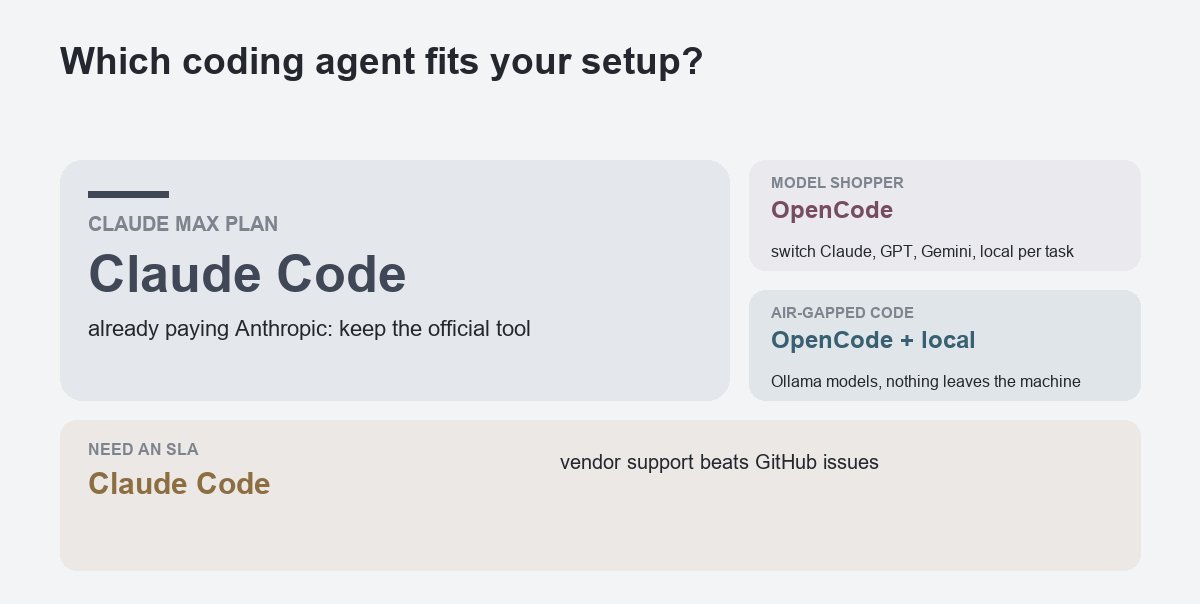
- You already pay for Claude Max. Stay on Claude Code. You are buying the models anyway, and the official harness squeezes the most out of them.
- You switch models by task. OpenCode. Swapping Claude for GPT or Gemini is a config change, not a tool change.
- Your code cannot leave the building. OpenCode with a local model through Ollama is the shortest path; Claude Code can do it since Ollama v0.14, with one more moving part.
- You need an SLA and a help desk. Claude Code. OpenCode’s support channel is GitHub issues, and nobody owes you an answer there.
People who made the switch tend to name the same reason:
“Absolutely. I can run whatever model I want without having to hack it.”
– r/opencode, August 2026 (9 upvotes)
FAQ
Is there anything better than Claude Code?
OpenCode, OpenAI’s Codex CLI, and Cursor all beat Claude Code on specific axes: model choice, GPT integration, and IDE polish respectively. None of them beats it at running Claude models with vendor support, which is the one job Anthropic reserves for its own tool.
Can I use Claude models inside OpenCode?
Yes, through an Anthropic API key, and the coding behavior is close to what Claude Code delivers with the same model. Signing in with a Claude subscription from a third-party tool is the shakier route, since Anthropic has tightened OAuth access for outside harnesses.
Can OpenCode use ChatGPT?
OpenCode can use OpenAI models such as GPT-5.x through an OpenAI API key, which is the same brain that powers ChatGPT. A consumer ChatGPT subscription does not plug in; API billing is the supported route.
Whichever you pick, keep expectations honest about the shared weakness: builder.io’s comparison found neither tool handles visual UI work well, so a frontend-heavy team still ends up checking layouts by hand. Both harnesses also share the same growing skills ecosystem, and it now reaches past code: the agent that writes your functions can cut product videos through HyperFrames, whichever side you pick. Try OpenCode free against the models you already have access to; if that experiment leaves you wanting Claude’s models specifically and often, the Claude Code subscription is the honest next step.

