


The mannequin alternative spelling is manikin. The choice between the two forms follows the job the model does: a mannequin displays clothing in a shop or a window, and a manikin stands in for a human body in medicine, first-aid training and anatomical study. Both spellings are accepted by the dictionaries we checked.
We read the labels in those dictionaries instead of repeating the rule from memory, and the labels disagree with each other in a way that matters. Some reference works file manikin under mannequin as a variant. Others give it a headword of its own and hand it the medical sense. That split is where most of the confusion comes from, not from anything about geography.
Which mannequin alternative spellings the dictionaries recognise
All three forms are in the dictionaries, but they are labelled differently, and one of them is doing less work than people assume. The table below records what each entry says on the day we read it.
| Reference work | mannequin | manikin | mannikin |
|---|---|---|---|
| Oxford Advanced Learner’s Dictionary | Headword: a model of the human body, used for displaying clothes in shops | Headword: a model of the human body that is used for teaching art or medicine; the entry adds “compare mannequin” | Listed in the manikin entry as an alternative form |
| Cambridge Dictionary | Headword: a large model of a human being, used to show clothes in the window of a shop | Headword, under the sense label MODEL: a model of the human body, used for teaching medical or art students | Listed in the manikin entry as an alternative form |
| American Heritage Dictionary, 5th edition (via TheFreeDictionary) | Separate headword: a life-size representation of the human body used for fitting or displaying clothes; a dummy | Headword given as “manikin or mannikin”: a mannequin; an anatomical model of the human body for use in teaching | Same headword line as manikin; treated as a variant of manikin |
| Collins English Dictionary, 12th edition (via TheFreeDictionary) | Headword, listed under Clothing and Fashion and under Art Terms | Separate headword; its clothing and art senses are recorded as “variant spellings of mannequin” | Separate headword: “a variant spelling of manikin” in medicine, art and clothing |
| Dictionary.com | Headword, with the note “Or manikin” | Shown as “a variation of mannequin”; also “Or mannikin” | Listed as an alternative form inside the manikin entry |
| Wiktionary | Headword; alternative forms listed as manikin and mannikin, plus the obsolete manequin | Headword; one of its senses is written as “alternative spelling of mannequin”, cited to a 1951 Time film note | Listed as an alternative form inside the manikin entry |
Two patterns come out of that table. The general dictionaries cross-reference the two spellings, so whichever one you look up will point at the other. The learner’s dictionaries do something sharper: Oxford and Cambridge divide the senses instead of merging them, so manikin is the anatomical and artistic model and mannequin is the shop-window one.
That is enough to settle most cases. A retail or fashion context takes the q-form, and a medical, training or art-class context takes the k-form.
Mannikin is the third form, and it is weaker than the other two. It appears inside the manikin entries rather than carrying its own entry anywhere we looked, and Collins files it as a variant spelling of manikin across medicine, art and clothing alike. It is not a mistake, but it is not a form you need either.
One reference we would normally check is missing from that table. Merriam-Webster’s dictionary and thesaurus pages return a 403 to scripted requests, so we have no label from it and will not assert one here. If you have a Merriam-Webster entry open in front of you, read its own labelling instead of taking ours second-hand.
Where the two spellings came from
The mannequin alternative spelling that circulates as the medical one, manikin, got into English first. It arrived in the 1560s from Dutch, and it already meant a jointed model of the human figure.
Mannequin came by a different road. The French word is 15th-century, but English only took it up for the clothing-display sense in 1898, according to Etymonline, which records manikin as coming from manneken, “little man”, and notes that the sense and the spelling of the two words were “often blended”.
That order explains the labels in the table. The older word got the technical senses, because it was already there when anatomists and art teachers needed a term. The newer one came in with the fashion trade, which is why mannequin reads as display and manikin reads as teaching.
What usage data shows about the split
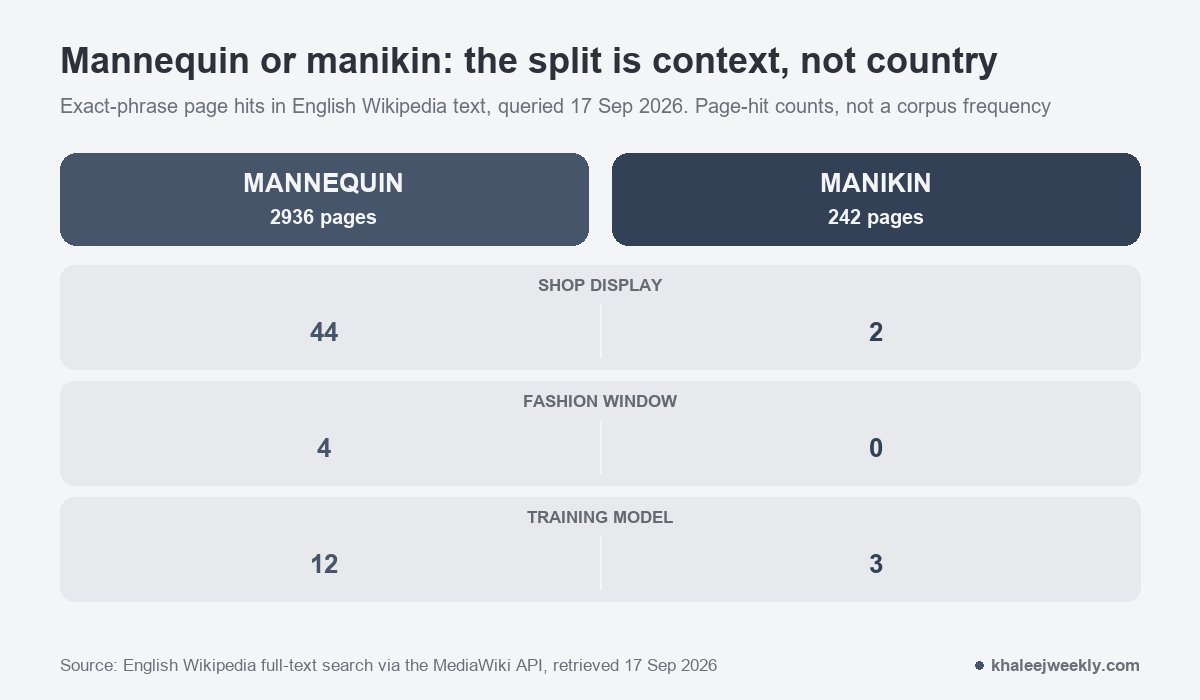
The context rule holds up in real text, with one exception. Retail and display phrases favour the q-form heavily: “mannequin head” appears on 44 pages of English Wikipedia and “manikin head” on 2. “Mannequin display” returns 5 against none for “manikin display”.
Those counts come from our own query of Wikipedia’s full-text search through the MediaWiki API on 17 September 2026, run on exact phrases. Wikipedia’s encyclopaedic text is not a corpus of shop copy, which is why the display gap is the clearest signal in the set.
The training sense runs the other way, though it depends on the phrase. “Training manikin” returns 3 pages against 12 for “training mannequin”, so the medical and training vocabulary is not as fixed on the k-form as the rule suggests. The exception is narrow: it shows up in general prose about training, not in the specialist literature, where the k-form is standard.
Read the numbers for what they are. These are page-hit counts over Wikipedia’s English text, not a corpus frequency. The search does not stem endings, so singular and plural were queried separately; longer pages are not weighted more heavily than short ones; and Wikipedia’s encyclopaedic prose over-represents science and history relative to shop copy. The counts say nothing about the Gulf, about retail writing, or about speech.
Is it a British and American difference?
British and American English use the same rule, so there is no regional swap to learn here. Oxford, Cambridge, Collins and Dictionary.com all list both spellings, and none of them marks manikin as American or mannequin as British. The difference readers are sensing is between senses, not between countries.
Two details make the question feel regional when it is not. Dictionary.com carries separate American and British columns, and it cross-references the two forms in the American one while leaving the British entry for manikin to stand alone. Oxford lists mannequin’s “person who models clothes” sense as old-fashioned, which makes the word feel more specifically British than it is.
A real British and American pattern exists elsewhere in the language, and this pair does not follow it. A nineteenth-century dictionary tradition produced the -our, -re and -ise forms that British English kept and American English simplified. Manikin and mannequin were never part of that. They split by what the model is used for, and the split is the same on both sides of the Atlantic.
What does change between markets is the noun you reach for when the word itself is not the point. British retail and tailoring writing tends to say dress form, dressmaker’s dummy or tailor’s dummy; American writing reaches for dress form as well, and for dummy. All of those are separate words, not alternative spellings.
Mannikin, manequin, maniquin: what to do with the rest
Mannikin is acceptable and unnecessary, while manequin and maniquin are malformed and should be replaced. The first has dictionary entries behind it in American Heritage and Collins. The other two turn up in text but appear in no entry we read, and Wiktionary files manequin as obsolete.
- Mannikin — a listed variant, mostly of manikin. Fine to leave alone; no reason to adopt it.
- Manequin, maniquin, mannequinne — not recorded in the entries we read. Replace with mannequin or manikin according to context.
- Mannequins, manikins — the plurals. Both follow the ordinary English pattern, with no internal change to the stem.
The plural trips people up more than the spelling does, because the q-form keeps its u before the s: mannequins, not mannequins with the u dropped. The possessive follows the same shape, as mannequin’s and manikin’s.
Neither plural changes the stem.
Words that are not alternative spellings
Manakin is not a third spelling, and treating it as one is the most common error in this family of words. It is the name of a bird family, Pipridae, of small passerine birds in the American tropics, with 55 species according to Wikipedia’s article on the group. The name comes from the same Middle Dutch source, mannekijn, which is why the two sound identical.
Manakin’s counts in Wikipedia’s text, 322 pages for the singular and 289 for the plural, are bird pages. A writer who swaps mannequin for manakin has not fixed a spelling; the subject has become a tropical songbird. Merriam-Webster’s thesaurus for mannequin lists manikin among its synonyms, and manakin is not among them.
The other words that get confused with mannequin are synonyms or near-synonyms, not spellings. Lay figure is the artists’ term for a jointed model, and American Heritage gives it as an alternative name inside its mannequin entry.
Dummy covers both the display and the training object, and crash test dummy is the fixed phrase for the vehicle-testing one, which appears on 169 Wikipedia pages. Resusci Anne, the CPR training manikin modelled on an unidentified woman drawn from the Seine, is a product name rather than a generic noun; the Laerdal page that competitors cite for the story now returns a 404, so we have not repeated its details.
“Mannequins and manikins should be spelled “manakin” as in, akin to man”
– r/CrazyIdeas, November 2025 (80 upvotes)
Mannequin spelling: the questions that follow
What are some other ways to spell mannequin?
Manikin is the standard alternative, and mannikin is a listed but weaker variant. The mannequin alternative spelling manakin is a different word, the name of a bird family, and manequin and maniquin appear in no dictionary entry we read.
Is there another word for mannequin?
Yes. Lay figure is the artists’ term, dress form and tailor’s dummy cover the display object, and dummy or model covers the rest. Those are synonyms rather than spellings, so they do not replace mannequin in every sentence.
How do you spell manikin in the UK?
Manikin, the same as in the United States. British dictionaries list manikin and mannequin as variants with the same sense split, so the q-form displays clothing and the k-form is the medical and artistic model.
What is the plural of mannequin?
Mannequins, with the u kept before the s. The plural of the k-form is manikins, and the possessives are mannequin’s and manikin’s. No plural drops the u or doubles the n.
The short version
Use mannequin for anything that displays clothing and manikin for anything that stands in for a body in medicine, first-aid training or art teaching. The mannequin alternative spelling mannikin is a listed variant with nothing to recommend it over the other two, and both main forms are standard in British and American English.
