


The Dubai Crown Prince is Sheikh Hamdan bin Mohammed bin Rashid Al Maktoum, the second son of Sheikh Mohammed bin Rashid Al Maktoum, the ruler of Dubai. Hamdan has held the title since 2008 and publishes poetry under the pen name Fazza. He turned 44 on 14 November 2026.
Most of the questions asked about him are really questions about someone else, or questions no published source answers. The three-finger gesture in a thousand Dubai photographs belongs to his father, not to him. And the number of wives he has, or the size of his private fortune, appears in no citable record at all.
What the Dubai Crown Prince does now
Hamdan bin Mohammed has been Minister of Defence of the United Arab Emirates and Deputy Prime Minister since a cabinet reshuffle announced on 14 July 2024, in addition to the crown princership he has held since 2008. He is also chairman of the Dubai Executive Council and of the Dubai Sports Council.
The defence portfolio is the part of the title that changed most recently, and it changed what the crown princership now carries. Until July 2024, the role was largely a Dubai one: chairing the emirate’s executive council, sponsoring its campaigns, fronting its projects. The reshuffle, announced by his father on X, moved a federal ministry into his hands and added the deputy premiership on top.
A crown prince with a defence ministry is not a ceremonial figure. The public schedule shows it.
Day to day, the executive council chairmanship puts him across the emirate’s government departments, its budget cycle and its infrastructure programmes. He has chaired the committee running the Mohammed bin Rashid Leadership Medal, approved its first recipient, and launched the International Space Cooperation Programme with a reported AED 1 billion behind it. Those are administrative facts rather than magazine ones. He also fronts the Dubai Fitness Challenge, the annual push asking residents to take 30 minutes of exercise a day for 30 days. It is the piece of his public work with the widest reach inside the city, which is why his name sits alongside sports facilities and running tracks as often as it does alongside palaces.
His own site, hamdan.ae, publishes the engagements: airport reviews with Emirates and Dubai International, medal committees, space programme launches. Anyone trying to answer where Prince Fazza is right now is better served by that site, or by his Instagram, than by a magazine profile. Social posts show a daily mix of climbs, endurance rides and ministry work. The feed is the closest thing to a live record that exists.
The emirate’s screen output does something similar. Dubai’s most-watched television exports are the reality slates built around the city, from Dubai Bling to Desi Bling and Love Is Blind Habibi, and they carry an image of the place that his official diary never will. The searches they generate land on his name anyway.
How many wives the Dubai Crown Prince has
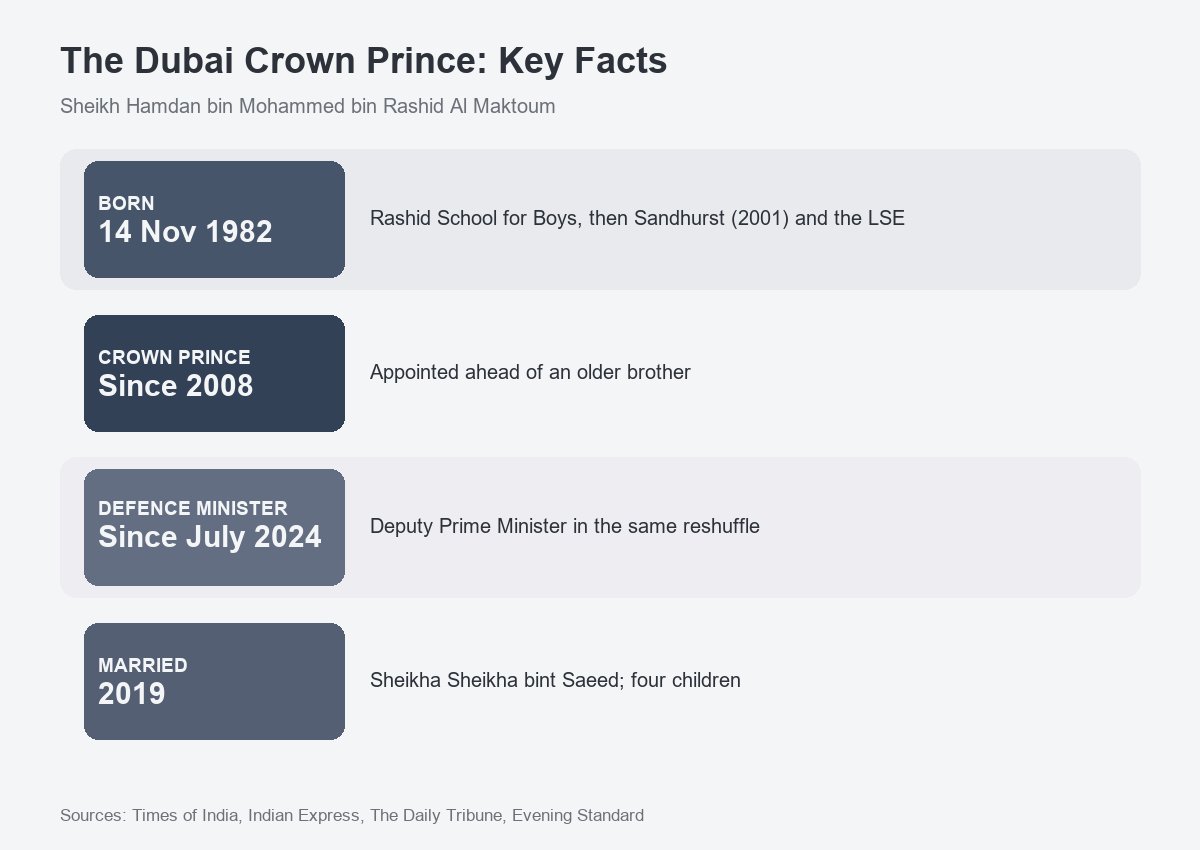
One wife is on the public record. Sheikh Hamdan married Sheikha Sheikha bint Saeed bin Thani Al Maktoum in 2019, in a joint ceremony that also covered two of his brothers, Sheikh Maktoum and Sheikh Ahmad. She is his cousin. No second marriage has ever been reported.
That single ceremony is the source of most of the confusion around this question. Three royal weddings took place together in 2019, which is why searches for his brothers spike at the same time as searches about his wife. Coverage often describes the event in the plural, and readers reasonably conclude that one man married more than once.
Where the record is full, it is very specific. The bride is identified by name and by family line, the year is fixed, and the ceremony’s other participants are named. That is a better-documented marriage than most royal unions in the Gulf. It is also the whole of the marital record.
Where the record is empty, it is completely empty. No official biography, no court notice and no credible news report lists additional wives. The absence is worth stating plainly. A reader who wants a number will find claims, and none of them trace back to a source that can be checked.
The four children and the line of succession
Sheikh Hamdan and Sheikha have four children: twins Sheikha and Rashid, born in May 2021; Mohammed, born in February 2023; and Hind, born in March 2025. He announced Hind’s birth on Instagram, naming her after his mother, Sheikha Hind bint Maktoum bin Juma Al Maktoum.
The names repeat inside the family on purpose. Rashid is also the name of Hamdan’s older brother, who died in 2015. Mohammed is his father’s name. Hind is his mother’s. In a ruling household, a child’s name is a statement about which part of the family the child descends from and which part they are expected to carry forward.
The succession detail that explains the household questions is this: Hamdan was appointed Crown Prince in 2008 despite having an older brother. His father’s choice skipped the birth order, and the reason looks more like a working decision than a personal one. Hamdan had already been Deputy Ruler of Dubai from 2006 to 2008 and was chairing the executive council. The job came first.
Sheikh Rashid bin Mohammed died of a heart attack in 2015 at 33. By then the line had already moved, so his death changed nothing about who succeeds. It did settle the next generation’s shape, though. Hamdan’s four children are the direct continuation of the Dubai line rather than a branch of it.
How rich is the Crown Prince of Dubai
No published source gives Sheikh Hamdan’s personal fortune, so the honest answer here is a boundary rather than a figure. What is documented is where the plausible numbers come from, how the family’s wealth is actually held, and what the record does and does not show.
Reports that quote a number for him are almost always quoting his father’s wealth instead. Forbes has listed Sheikh Mohammed bin Rashid among the world’s richest royals, and the magazine has estimated his fortune at $16 billion at its highest, while the Evening Standard recorded an estimated $13.9 billion for him in 2013.
Both numbers describe the ruler, not the Crown Prince. The gap between them is a useful warning: a thirteen-year-old estimate and a Forbes listing are not the same measurement, and neither one belongs to Hamdan.
Family wealth in Dubai does not sit in a personal bank account. It is held through holding companies, family offices and state-linked enterprises, which is why no reliable private net worth exists to publish. Analysts who cover Gulf royal finances describe consolidated family interests, not individual balance sheets.
What can be named are the visible commitments. He founded the Hamdan bin Mohammed International Photography Award, known as HIPA. He keeps an endurance-racing stable, and he won individual gold at the 2014 FEI World Equestrian Games. Endurance racing at that level is a serious annual cost, and it is a cost with a public record attached to it.
The reported luxuries are a different category. Coverage has put his stable at over 1,000 horses and 120 camels. Social media posts have shown him flying first class on Emirates and riding the London Underground in the same week. Those details are colourful and sourced to the posts themselves. They are not an income statement, and no honest reading of them produces a net worth.
Why three fingers show up in Dubai pictures
The three-fingered salute belongs to Sheikh Mohammed bin Rashid, the ruler of Dubai, not to the Crown Prince. He explained it at the Government Summit in February 2013 as a personal emblem standing for three words: win, victory and love. Within months, a Dubai event was named after it.
The gesture travels because it is easy to copy. It appears in school assemblies, National Day parades and sports crowds, and it shows up in photographs beside Hamdan without being his. The confusion is geographic rather than personal. The salute is a Dubai and UAE symbol, and the Crown Prince is who people picture when they think of Dubai.
Hamdan has his own visual signature, and it is a different one. He is the photographer, not the subject of a hand sign: HIPA, the infrared cityscapes, the wildlife frames from Tanzania and Iceland. Search for his images and the recurring motif is a camera, a horse, or a mountain ridge.
Worth separating the third guess as well. The three-finger salute is not a religious gesture or a coded political message, so it needs no reading beyond the three words the ruler gave it. It became famous first as a government-communications idea. It stayed famous because a country of expatriates and visitors can perform it without needing to know anything else about the UAE.
Common questions about the Dubai Crown Prince
How many sons does the Dubai Crown Prince have?
He has two sons. Rashid was born in May 2021 as one of a twin pair with his sister Sheikha, and Mohammed was born in February 2023. Both names are drawn from close family, which is standard practice in the ruling line.
Where is Prince Fazza right now?
There is no live tracker, and the best available record is his own output. Hamdan publishes engagements on hamdan.ae and posts to Instagram as @faz3, where the feed mixes official duties with climbs, rides and travel. For anything current, those two are the primary sources.
Did the Crown Prince of Dubai get married?
Yes. He married Sheikha Sheikha bint Saeed bin Thani Al Maktoum in 2019, in a joint ceremony shared with his brothers Sheikh Maktoum and Sheikh Ahmad. She is his cousin, and the marriage is the only one on his record.
What is the Dubai Crown Prince’s net worth?
None is published. Every widely quoted figure belongs to his father, Sheikh Mohammed bin Rashid, whose fortune Forbes has estimated at $16 billion. Dubai’s ruling family wealth is held through companies and state-linked bodies, so no verified personal total exists.
How old is Prince Hamdan?
He was born on 14 November 1982, so he is 44, having marked his birthday on 14 November 2026. He was educated at Rashid School for Boys in Dubai, then Sandhurst, graduating in 2001, and later at the London School of Economics.
Is Fazza the same person as Sheikh Hamdan?
Yes. Fazza is the pen name Hamdan has used since his teenage years for Nabati Arabic poetry, and it is the name he uses on Instagram. In 2019 he published For the Love of Horses, an 18-poem bilingual collection.
Every question above has an answer that can be pointed at, and the two that do not have one are the two most often answered anyway. A title inherited in 2008, a ministry added in 2024 and four children named after four relatives are the record. Read that record and the subject is clear enough. Skip it and the numbers will be supplied by whoever is willing to guess.

