


Which are the best sleep tracking apps? Not one group. Accuracy splits in two: sleep-versus-wake detection sits near 85% even in clinical testing, while four-stage classification falls to about 53%. Pick the app for the measurement you intend to act on.
We have read the validation studies rather than the marketing pages, and the gap between those two numbers changes what a buyer should look for. A listicle that prints one accuracy percentage is describing only half of what the device does. What separates the best sleep tracking apps from the rest is what the app can physically measure, and what you are willing to pay for it every month.
Quick facts
- Strongest measurement tier: EEG headbands, which read brain activity directly. Muse S Athena was listed at $474.99 USD on choosemuse.com when checked on 18 September 2026.
- Weakest tier: phone-only apps, which work from microphone and motion data and never measure a sleep stage.
- Cheapest complete option: AutoSleep, a one-time purchase listed at $8.99 in the US App Store on 18 September 2026, with no subscription.
- Recurring cost to compare against: SleepWatch Premium at $4.99 a month or $39.99 a year, per its App Store listing.
- The trend matters, not one night. In the 2025 clinical study below, one ring’s total sleep time estimate was off by up to 97.5 minutes on a single night even though its average error was under 12 minutes.
What are the best sleep tracking apps?
For most people the best sleep tracking apps come down to two: Sleep Cycle needs no extra hardware, and AutoSleep is the better buy if you already wear an Apple Watch and want to pay once. Muse S Athena is the choice only if you need stage data, since it is an EEG headband.
That answer is deliberately conditional, because the question hides two different purchases. One buyer wants to know whether they slept. Another wants to know how much deep sleep they got.
The first question has a good answer nearly everywhere. The second does not, and the app that answers the first well is not automatically the app that answers the second.
How accurate are sleep tracking apps?
Sleep tracking apps are roughly 85% accurate at telling sleep from wakefulness and about 53% accurate at sorting sleep into four stages, according to a 2025 validation study in Scientific Reports. The same devices produce both numbers, and the four-stage figure is the one most sleep scores are built from.
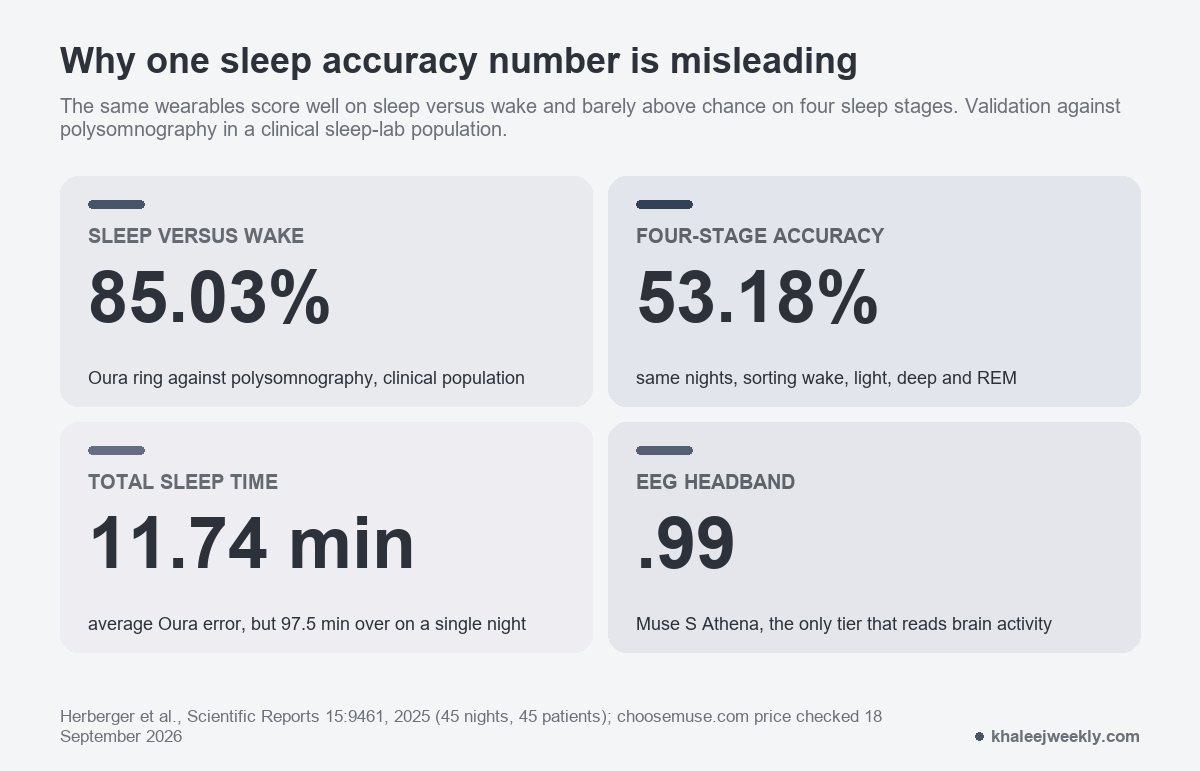
That study, by Sebastian Herberger and colleagues at Charité and the University of Zurich, put three commercial ring trackers against polysomnography, the supervised lab recording that measures brain activity, eye movement and muscle tone. It ran over 45 nights in 45 patients at a university sleep lab, so the sample is people whose sleep was disordered enough to be referred, not healthy adults.
| Sleep measurement | What it detects | Reported accuracy | Source and limit |
|---|---|---|---|
| Sleep versus wake | Whether you were asleep at all | Oura 85.03%, SleepOn about 85%, Circul about 65% | Herberger et al., Scientific Reports 15:9461, 2025; clinical sleep-lab patients |
| Four-stage classification | Wake, light, deep and REM, sorted correctly | Oura 53.18%, SleepOn 50.48%, Circul 35.06% | Same study, epoch-by-epoch comparison against polysomnography |
| Total sleep time | How long you slept | Average error under 12 minutes; a single night ranged from 54 minutes under to 97.5 minutes over | Same study; the average hides the nightly spread |
| Deep sleep and REM | Stage duration | Deep sleep off by about 6 minutes on average but with a 353-minute spread; REM overestimated by about 32 minutes | Same study; individual nights are much less reliable than the average |
Oura has disputed the framing rather than the figures. Its own response describes the advertised 95% as sleep-versus-wake sensitivity, and the healthy-adult study it relies on reported 95% sleep sensitivity alongside 76% four-stage agreement, as reported by MD+DI. The two companies’ numbers differ mainly because the populations differ.
A California buyer, Madison Surber, filed a proposed class action against Oura in the Northern District of California on 20 August 2026, arguing that “95% sleep staging accuracy” misleads buyers. The complaint’s subject is the wording, not a broken sensor.
Folding four sleep stages into two makes the task easier, which is why the gap exists. Wake, light, deep and REM each need an independent call. Even the best published four-stage classifier that works without brain signals, using ECG, blood oxygen and movement together, reaches about 83% agreement, MD+DI reports.
What follows from the table matters more than the table. When an app reports that you had 40 minutes of deep sleep, the underlying measurement is closer to an estimate than a reading, and the honest use of it is comparison across weeks rather than judgement of a single night. A four-stage accuracy near 53% cannot support a decision about medication, which is why the score is a wellness number and not a clinical one.
Free, freemium and one-off: the best sleep tracker without a subscription
The best sleep tracker without a subscription is AutoSleep, which is a one-time purchase rather than a recurring charge. In the US App Store on 18 September 2026 it was listed at $8.99 with no in-app purchases, and it states plainly that there are no ongoing subscriptions. It needs an Apple Watch, which is a real condition rather than a footnote, and it is the only one-off option among the best sleep tracking apps that still ships full reports.
The Apple Watch is the catch.
| If you want | Sleep tracking app | Listed cost (US storefronts, checked 18 September 2026) | What the free or base tier gives up |
|---|---|---|---|
| No subscription at all, iPhone plus Apple Watch | AutoSleep | $8.99 once | Nothing; there are no in-app purchases, but Apple Watch is required |
| No hardware beyond a phone, Android | Sleep as Android | Free with ads and in-app purchases after a 7-day premium trial | Advanced sound analysis and some smart-alarm features sit behind the upgrade |
| No hardware beyond a phone, iPhone | Sleep Cycle | Free with in-app purchases; the site advertises a 60-day trial | Long-term trends, data export and the sound library are premium |
| Deepest reports and willing to pay monthly | SleepWatch | Free, Premium at $4.99 a month or $39.99 a year | Coaching, smart alarm, snore tracking and full reports need Premium |
Sleep Cycle is the sensible default for phone-only tracking, since it works from the microphone and accelerometer and needs no wearable, and its sleep-notes feature is the one part of the free tier that earns its place. That feature lets you tag a night with coffee, stress or exercise and then see the score against those tags, which is the same week-over-week comparison the accuracy data supports, just with your own inputs attached. It is also the app most often named in the question “is Sleep Cycle free”, and the answer is that the tracking is free while the useful long-term view is not.
AutoSleep, meanwhile, has taken criticism. Andrei Karpathy’s two-month comparison of Oura, Whoop, 8Sleep and AutoSleep found AutoSleep’s daily score swung so widely that it correlated poorly with the way he felt, and he rated it the weakest of the four. That is a fair complaint about a composite score. It is not a measurement of the deep-sleep or REM figures, and the disagreement is about what the score is for rather than whether the app works.
Best sleep tracking app for your problem
Match the app to the problem rather than to the brand. A snoring or possible-apnoea concern needs a recorder and a doctor, a deep-sleep concern needs an EEG headband to be worth paying for, a routine concern is served by the free tiers, and a low mood about the score itself is a reason to reduce tracking rather than buy more of it.
Snoring and suspected apnoea come first because they are the cases where an app can change a medical outcome. Sleep as Android and Sleep Cycle both record night audio and flag snoring, and both can show breathing patterns across a night. Neither diagnoses anything. The clinical test for apnoea is a sleep study, and a tracker that shows repeated drops in blood oxygen is a reason to book one, not a substitute for it.
If your concern is deep sleep, pay for the sensor rather than the software. The clinical study above found the Circul ring correctly identified only 17% of deep-sleep epochs, and even the better-performing Oura ring missed the duration by an average of about 6 minutes with individual nights landing anywhere inside a 353-minute range.
An EEG headband such as the Muse S Athena reads brain activity directly, and it was listed at $474.99 USD on the manufacturer’s site on 18 September 2026. That is the price of the precision, and it is the only tier in this comparison where a stage reading is a measurement rather than an estimate.
For routine and habit, the free tiers are enough. Sleep Cycle’s own front page now leads on routine, arguing that consistency predicts health better than duration does, and a free tier that logs bedtime and wake time is sufficient to see that pattern. Paying for a sleep score does not improve the routine; going to bed at the same time does.
For anyone already wearing a smartwatch, the useful question is what the watch can see. A wrist device reads movement and heart rate, which supports sleep-versus-wake reasonably well and stage classification poorly. The owner of an Apple Watch who wants a better app is buying a better interface for the same underlying signal, and AutoSleep at $8.99 once is the cheapest way to find out whether that is enough.
“The tech really isn’t here to get great sleep tracking. AW from a duration and stages point of view is about as good as anyone elses if not better – but stages and duration is only of limited assitance depending on what you sleep focus is about. Battery life…” [excerpt, 664 characters in full]
– r/smartwatch, August 2026 (4 upvotes)
Do doctors recommend sleep tracking apps?
Doctors do not recommend sleep tracking apps as treatment, and some now warn about them. Sleep physicians quoted by the BBC in September 2026 said they were seeing more patients fixated on achieving a perfect sleep score, a pattern called orthosomnia, and that the fixation can make sleeplessness worse, Juta MedicalBrief reported.
Apps are used as a behavioural aid, not as a diagnostic. The reason is structural: a tracker produces a probability, and the patient needs a diagnosis.
The one clinical development worth knowing is that the FDA cleared SleepStageML in 2024 to score sleep stages, and it does so by taking real polysomnography signals as input and returning its output to a clinician for review, as reported by MD+DI. The distinction is the clinician and the input, not the software.
What doctors do act on is the history a tracker makes easy. If your app shows repeated breathing pauses or a blood-oxygen reading that drops through the night, that is a reason to be referred. The MedicalBrief report on the BBC findings includes patients bringing tracker data to appointments, which is useful when it is a pattern over weeks and unhelpful when it is one bad Tuesday.
There is also a group for whom tracking is the wrong purchase. If checking the score at 3am has become part of the problem, the value of another subscription is negative, and a GP or a sleep clinic is the better next step.
Frequently asked questions
What is the most accurate sleep tracker?
An EEG headband such as the Muse S Athena is the most accurate option, because it measures brain activity and sleep stages are defined by brain activity. Wrist and ring trackers reach about 85% on sleep versus wake but only about 53% on four-stage classification in clinical testing.
What is Matthew McConaughey’s sleep app called?
McConaughey does not have a sleep tracking app. He narrates sleep stories for Calm, which Calm’s own help centre lists under its Celebrated Voices category. Calm is a meditation and sleep-story app, and it does not track sleep stages.
What is the best sleep tracker without a subscription?
AutoSleep is the best subscription-free choice if you own an Apple Watch, because it is a one-time $8.99 purchase with no in-app purchases. Sleep as Android and Sleep Cycle are free to start on a phone, but both hold advanced features behind a paid upgrade.
Which sleep tracking app is best for Android or iPhone?
Sleep as Android is the strongest phone-only option on Android, with sonar tracking that works without a phone in the bed. On iPhone, Sleep Cycle is the equivalent default and AutoSleep is the better buy if you also wear an Apple Watch.
Are free sleep tracking apps worth using?
Yes, for duration and routine. A free tier that logs bedtime, wake time and total sleep gives you the trend that the evidence supports acting on, which is consistency rather than a nightly score. Stage breakdowns are where free sleep tracking apps thin out, and where the measurement is weakest anyway.
