


A flat white is espresso with steamed milk in a small cup, and it carries less milk and less foam than a latte. A double espresso, around 130ml of steamed milk and a thin layer of microfoam is the classic build.
Two flat white coffee drinks on the same menu can look identical at the counter and taste nothing alike, because the cup you get depends on how much milk goes in and how finely it is steamed. Those are the two variables worth watching before you order.
What is a flat white?
A flat white is espresso with steamed milk in a small cup, usually 160ml to 200ml, and the milk is stretched into microfoam instead of a foam cap. Less milk and a thinner texture leave the espresso more exposed, which makes the drink taste stronger than a latte built from the same coffee dose.
- What goes in: a double espresso, about 130ml of steamed milk and roughly 5mm of microfoam, the build coffee writer Anette Moldvaer gives, as recorded in the Wikipedia entry for the flat white.
- Cup size: Tourism New Zealand puts the common serve at 175ml, while Australian cafés often use a ceramic cup closer to 200ml, the size of a latte glass.
- How it is textured: the milk is aerated into fine bubbles, so the surface is glossy and flat. A spoon standing up in the foam is a cappuccino, not a flat white.
- Where the name comes from: England used the term for an espresso drink in the 1960s, and the drink took its present form in Australia and New Zealand in the 1980s.
- What we check first: how much milk the café pours and how finely it steams it, because those two set the drink.
- Energy per cup: 34kcal to 76kcal in the same drink, set by the milk you choose.
Flat white coffee vs latte, cappuccino and cortado

A flat white and a latte differ in how much milk reaches the cup, a cappuccino differs in how much air goes into it, and a cortado is the smallest of the four. Order a flat white to let the espresso lead and a latte when you want the milk to lead.
| If this is what you want | Order | Typical cup | Milk and foam |
|---|---|---|---|
| Coffee first, milk as a texture | Flat white | ~175ml in New Zealand, ~200ml in Australia | About 130ml of milk, 5mm of microfoam |
| A milkier, milder cup to sit over | Latte | ~225ml | More milk, a softer and shallower foam layer |
| A light, foamy drink with a dry top | Cappuccino | 150ml to 180ml | Same espresso, far more air whipped in |
| Espresso with only a splash | Cortado | 120ml | One ristretto shot with an equal part of warm milk and no foam cap |
The drink probably began as a latte with less milk, and the fixed quantity of coffee separates the two in the cup. A café serving a 225ml latte and a 175ml flat white draws the same espresso for both, so the smaller vessel is the stronger drink.
The foam carries a second difference. Microfoam is thinner and glossier than the milk layer on a latte, and a cappuccino goes further still with a dry mound of air on top. Two cafés can pour the same 175ml and hand you different drinks, so ask for less milk or a finer texture when you want the ratio the name claims to fix.
Flat white coffee in numbers
The milk choice swings the energy in the cup far more than the cup size does. In the Starbucks UK Allergen & Nutrition Guide (version 17/03/26), we found a per-milk panel for the Short flat white, and the dairy-to-plant spread inside one drink is the part worth reading before you order.
| Milk in the same flat white | Energy | Protein | Caffeine |
|---|---|---|---|
| Almond drink | 34kcal | 0.9g | 89.1mg |
| Soya drink | 51kcal | 3.9g | 89.1mg |
| Coconut drink | 54kcal | 1.5g | 89.1mg |
| Semi-skimmed milk | 59kcal | 4.2g | 89.1mg |
| Oat drink | 68kcal | 1.2g | 89.1mg |
| Whole milk | 76kcal | 4.1g | 89.1mg |
Read the panel in three parts. Almond comes in at 34kcal and whole milk at 76kcal, a spread of 42kcal for one drink, and the oat version lands above semi-skimmed at 68kcal. Protein is the second signal: semi-skimmed carries 4.2g, oat 1.2g and almond 0.9g, so the protein falls as the drink gets lighter. Caffeine does not move at all, because the espresso is unchanged at 89.1mg across every version. We read those figures for the standard Short size; a larger cup and a different espresso blend will shift the energy, the protein and the caffeine together.
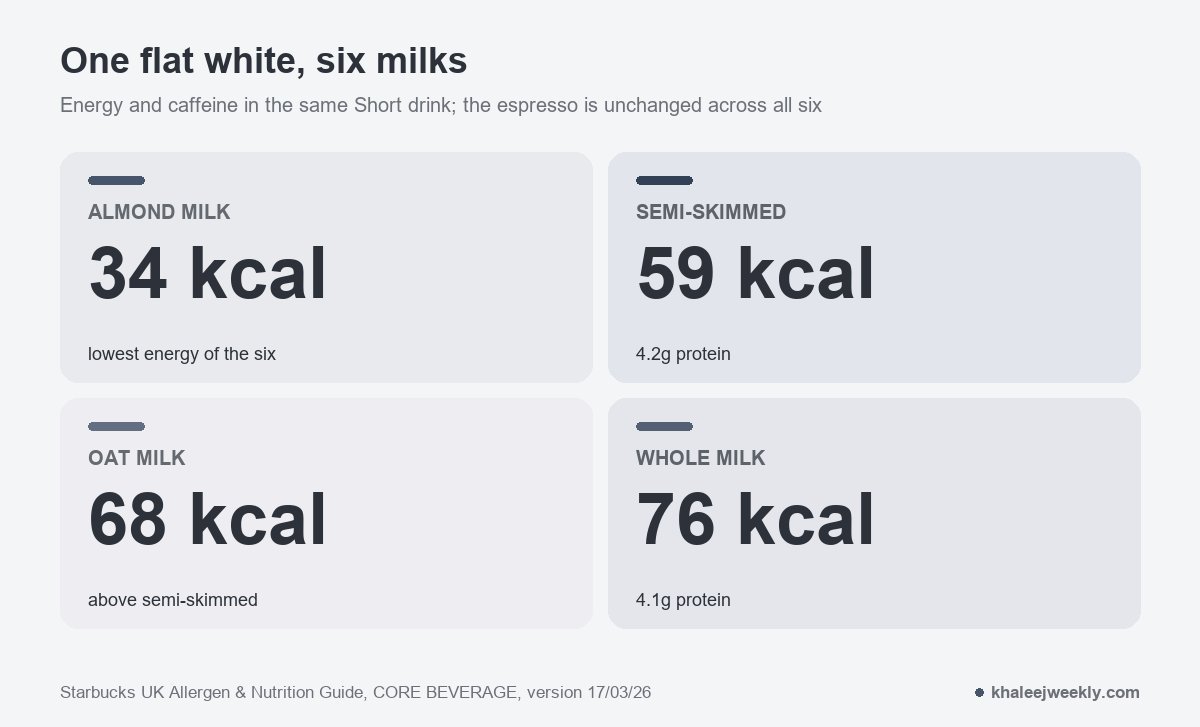
The milk changes the drink more than the cup does
Oat and coconut milks can leave the same flat white heavier than semi-skimmed, and the swap from dairy to plant is not a reliable way to lighten the drink. The panel above shows both crossing the semi-skimmed line at 68kcal and 54kcal against 59kcal, so the lighter-feeling choice carries more energy in two of the three common plant milks.
The plant versions also hold less protein, which matters if the cup counts as part of how you eat and not as a treat. Texture is the last piece. Whole milk and semi-skimmed steam into the most stable microfoam, and cafés get different results from oat and soya depending on the brand, because the fat and the protein in each one set how the bubbles hold.
What home steaming actually demands
Steam the milk and stop it at about 60C to 65C, which is where general barista practice puts the end of steaming. Past that point the foam stops building, the milk starts to smell cooked, and the drink flattens.
Stretch the milk for a few seconds at the start to draw in air, then keep the tip just below the surface while the jug warms, and knock the jug once on the counter so the larger bubbles break before you pour. We would start with whole milk. Its fat and the protein steady the foam while you learn where the tip sits, and plant milks vary enough between brands that the first carton is not the last word on what your machine can do.
A single shot from a home machine is also smaller than the double in a café build, so a home flat white lands thinner unless you pull two shots into the same 175ml.
Flat white questions
Two follow-ups the sections above do not settle: what changes when the flat white is iced, and whether the milk choice affects anything beyond the calorie count. We answer both in one line each.
Is an iced flat white the same drink? No. An iced flat white is espresso poured over cold milk and ice, so it loses the microfoam that defines the hot version. The coffee-to-milk ratio stays, and the texture does not.
Does the milk change anything besides the calories in a flat white coffee? Yes, the protein and the foam. Semi-skimmed carries 4.2g of protein per Short drink against 0.9g for almond, and whole milk holds a stable microfoam that thin plant drinks struggle to match.
