


Two territories are called Jura, and a deces jura request can land in either. The French département, numbered 39, counted 257,973 residents in the 2023 census. The Swiss canton of Jura reported 75,178 residents at 31 December 2025. Neither register refers to the other.
For a death in the French Jura, one fact decides where the entry sits: the year. The national index of deceased persons covers 1970 onwards. The mairie of the place of death issues the official certificate for any year, and the departmental archives carry digitised civil registers up to 1922.
A request written for a French mairie will not reach a cantonal register. The two Jurats sit in different countries, and each is governed by its own civil-status law.
Which Jura Holds the Record
Two jurisdictions share the name, and the unaccented form deces jura stands for both in file names and register indexes. Accents are commonly dropped outside French-language publishing, and the correct spelling is décès.
The French side is the département du Jura, territory number 39, with its prefecture at Lons-le-Saunier. Civil status there is a communal duty, and the officer of the commune where the death happened draws up the entry.
The Swiss side is the canton du Jura, whose capital is Delémont.
Its civil-status office answers for the whole canton, so a request never goes to a commune hall. That structural difference decides the outcome before any document is examined.
Acte de Décès or Avis de Décès: Two Different Documents
A deces jura entry can mean either of two documents. An avis de décès is the notice a family places in the press. An acte de décès is the official entry drawn up by the mairie. Banks, insurers and notaries accept that one.
The notice is easier to find.
Regional dailies carry them by local edition, and aggregators such as Libra Memoria re-index the lists that appear in Le Progrès for the Jura.
The official entry costs nothing either. Service-Public states that any person may request an acte de décès without particular justification. Applicants do not have to prove identity, and the page stood in that form on 13 August 2026.
The request goes by post to the mairie of the place of death. It can also be made in person at that mairie, at the mairie of the deceased’s last home, or through the online service.
The entry is created quickly. A hospital or care home must declare a death within 24 hours, under the rules for declaring a death. The mairie then draws up the acte whatever the deceased’s nationality.
What an applicant needs is not a document but two facts: the commune, and a date close enough to fix the year.
Deces Jura (39): The Source That Covers Your Year
In the French department, the year of the death picks the source for a deces jura entry. Every source has a limit worth knowing before a request goes out.
| The situation | The source that holds it | Cost | Its limit |
|---|---|---|---|
| A death in the last few weeks, with no commune known | Notice lists for the Jura edition, re-indexed by aggregators such as Libra Memoria | Free to read | Gives no certified copy |
| Any year, and an official copy is needed | Mairie of the commune where the death happened | Free, no justification required | The commune and an approximate date are needed |
| 1970 or later, with a name and a year | The Insee file of deceased persons, searchable free through matchID | Free | Cannot be used to certify the death |
| Before 1922 | Digitised parish and civil registers at the Archives départementales du Jura | Free online | The registers stop at 1922 |
| 1922 to 1969 | Decennial tables to 1942 online, later registers held by the archives and the mairie | Free | The stretch after 1942 is not searchable online |
The archives’ own guidance is precise about the boundary. The Archives départementales du Jura report that digitisation of the parish and civil registers is complete. The decennial tables of every Jura commune are available to 1942, and the registers themselves to 1922.
That leaves a band from 1922 to 1969 with no online register. Closing it means asking the mairie, which holds the entry for its own commune. The alternative is the archives’ reading room.
Anyone who has a year but no commune should start with the national index. It is the only source on the list that accepts a name on its own.
The Canton of Jura Keeps Its Own Register
Across the border the structure changes.
Civil status in Switzerland is federal law applied by the cantons. The canton of Jura runs a single civil-status office rather than a register in each commune.
Notices Appear in the Regional Press
Death notices for the canton are carried by regional outlets and the aggregators built on them. One of those lists is the cantonal notice page on funere.com, which gives a name, an age, a commune and a date.
Extracts Come From the Cantonal Office
The cantonal authority is the Office de l’état civil du Jura, inside the Service de la population. It handles requests about marriage, birth, death and recognition of paternity, and it decides what an applicant may be given. A supervisory authority for civil status sits above it, and the federal Office fédéral de l’état civil above that.
A deces jura request for Delémont, Porrentruy or any other Jurassian commune goes to that office. It does not go to a commune hall.
The Free National Index and Its Limits
Insee’s file of deceased persons is the fastest way to place a name.
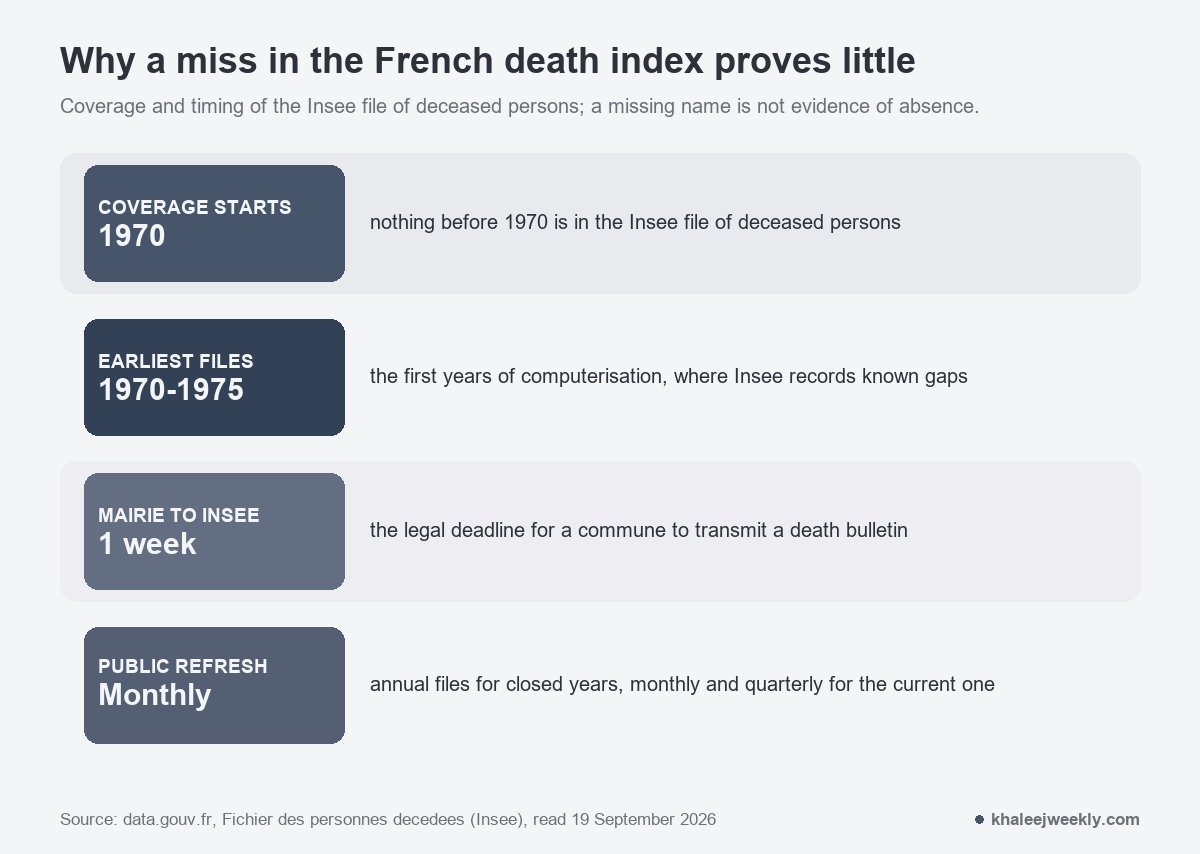
Its limits matter as much as its coverage. Files exist from 1970, annual for the years already closed and monthly or quarterly for the current one. They include deaths that happened abroad, according to the dataset page.
Freshness is not instant. Mairies have a legal deadline of one week to transmit death bulletins to Insee. A monthly file is built from the date Insee recorded the death rather than the date of death. A given month can therefore miss deaths that arrive later and include earlier ones.
The earliest years are the weakest. Insee notes that the 1970 to 1975 files date from the beginning of computerisation and may have gaps. Nothing before 1970 appears in the index at all, so an older deces jura entry has to come from the commune or the archives.
Insee states two limits that bear on evidence. It cannot guarantee the files are free of omissions or errors, and they may not be used to certify a person’s vital status.
Relatives can ask for a death to be entered in the opposition-to-rediffusion file. Redistributors must exclude those deaths.
The index is nonetheless widely used. Its dataset page counter read 3,813,379 views and 1,521,747 downloads on 19 September 2026, and a free front end at matchID runs on the same files.
What to Check Before Sending a Request
Three follow-ups decide where a request goes next: who may ask for the certificate, why the national index starts in 1970, and whether a hit in that index settles anything.
Can anyone request an acte de décès?
Yes. Service-Public states that any person may request an acte de décès without particular justification and without proving identity, and that the copy is free.
Why does the national index start in 1970?
Insee’s file of deceased persons begins with the 1970 deaths, the point at which the records were first held in that form. Nothing earlier appears in it, and the first five years are the least complete.
Does the index prove that someone has died?
It is evidence, not proof. Insee states that the files may not be used to certify a person’s vital status, and the official deces jura answer comes from the mairie’s acte de décès.
The certificate is free in France, open to any applicant, and issued by the commune where the death happened. Settling the year and the territory first is what keeps a deces jura request from going to the wrong office.

