


futbollibre is a rotating set of domains. Three of the addresses serving the name on 19 September 2026 had been registered on 16, 17 and 18 September, and the older addresses in the same family now sit switched off at the registry. A link passed around a group chat on a Saturday morning can be a dead address by the following weekend.
The name travels as a free alternative to a paid subscription, almost always in Spanish and almost always around a big fixture.
Its addresses get registered in bulk, dropped when a complaint lands, and replaced within days under a slightly different suffix. Registry records, the pages themselves and two enforcement files describe that arrangement from three directions.
What futbollibre is in September 2026
futbollibre is three things sharing one name: a set of Spanish-language pages that link out to live football, an Android app in Google Play, and a decade of court and press files about unauthorised broadcasts.
The oldest address in the family is futbollibre.com, registered on 20 March 2005 and still locked against transfer.
futbollibre.net followed on 22 March 2018 through MarkMonitor, a registrar that handles brand protection for large companies. futbollibre.org dates from 7 May 2021 and carries a client hold, which is the registry’s way of saying a name has been switched off.
The pages are the part people mean by the name. They open on the day’s fixtures, list sports channels by name, and hand the visitor off to a stream.
The Android app is a separate product with a separate developer, and the enforcement files concern the people who supplied the streams.
Google Play lists that app under the developer name Futbol Apps Pro, at 3.8 stars from 5,030 reviews, with more than a million downloads and an update dated 4 September 2026.
Its support address is a Gmail account and its privacy policy sits on an unrelated personal domain. The developer contact named on the listing is in Argentina.
The domain carousel behind the name, dated from registry records
Every domain in the family carries a creation date, and those dates do work that a general warning cannot do.
Of the three newest addresses, futbollibre.mobi was created on 16 September 2026, futbollibrefullhd.org on 17 September and futbollibre.one on 18 September. All three were live and carrying the name the following day.
The newest addresses under this name were therefore between one and three days old when they were serving football links.
Two of them went through the same registrar, Spaceship, and both resolve through the same pair of Cloudflare nameservers. The third used Dynadot and answers on CloudNS.
At the other end of the list, two names are suspended. futbollibre.org carries a client hold, and so does pelotalibre.com, the sister brand named in the same enforcement files.
A client hold is the registrar deactivating the domain in the registry. It stops resolving, and reloading does not bring it back.
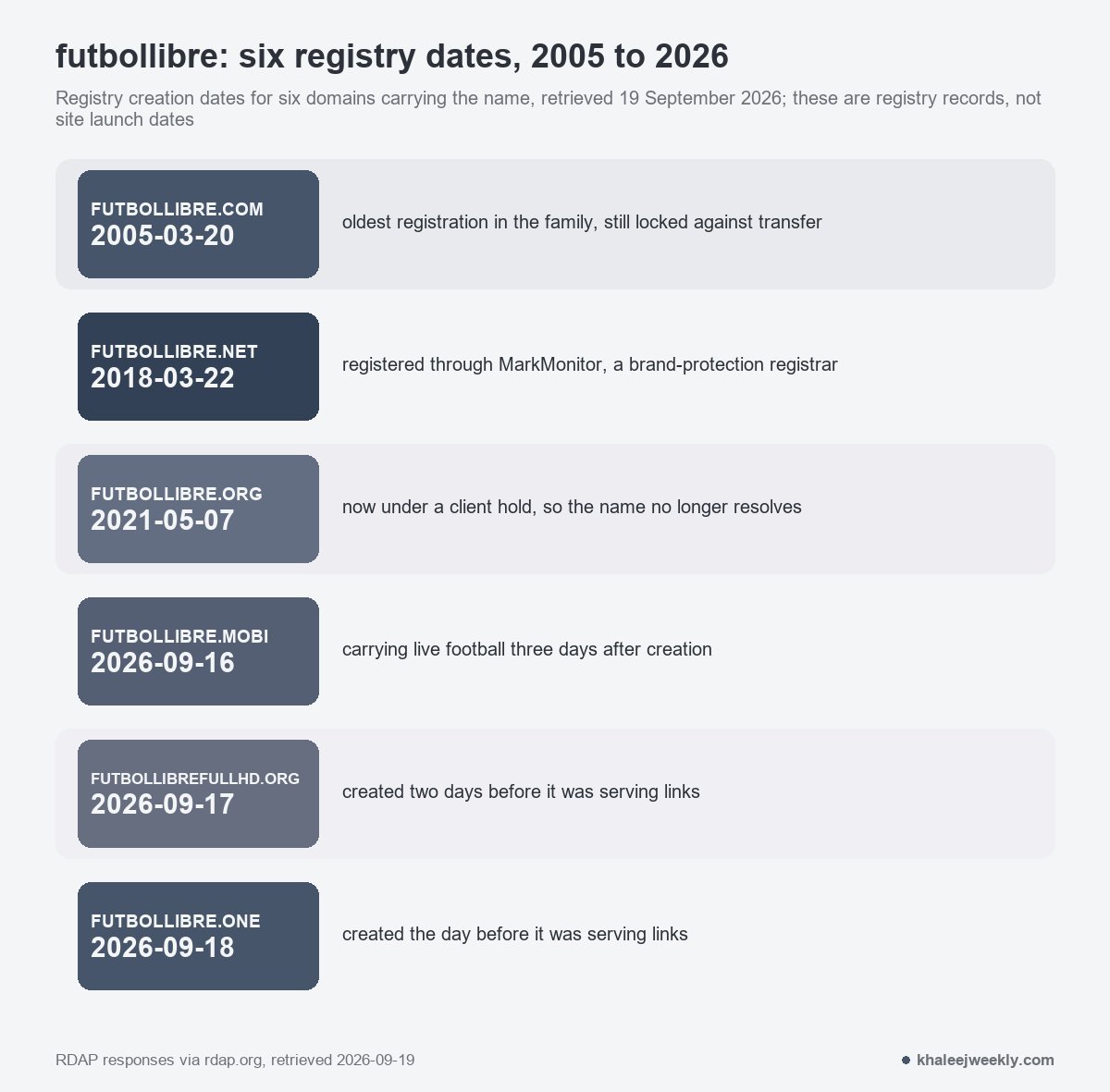
Read the two ends together and a dead bookmark stops being a mystery. A takedown takes down an address, and any name left unregistered can be picked up again within a day.
The new address then inherits the audience the old one trained. A handful of registry entries carry the whole lifecycle.
What the pages under the name actually hand you
What these pages serve first is a schedule. futbollibrefullhd.org opens on the day’s matches with a channel list beside it, and its own navigation leads to a separate agenda page.
futbollibre.mobi does the same for Mexican football and adds a row of channel buttons for the broadcasters it carries. The competitions those pages advertise are Liga MX, the Copa Libertadores, the Champions League and LaLiga, alongside the Argentine, Chilean, Peruvian and Ecuadorian leagues.
Neither asks for an account. futbollibre.mobi states that playback runs in the browser with no download required, then offers an APK directly underneath.
The same page invites visitors to a Discord server and a Telegram channel.
The audience for those links is not hard to find. A thread on r/PiratasEspanolLatino in September 2026 asked for something narrower than what the pages offer: football only, in Spanish, at 1080p, and working on a Fire Stick.
“Hey friends, I have a question. Do you know of any app that only has soccer events in 1080p and in Spanish? I have a list, but it doesn’t work quite well sometimes. I’d like to know if anyone has a good option that works on Fire Stick, or if you have a list, it would be awesome if you could share it. Thanks, guys.”
– r/PiratasEspanolLatino, September 2026 (9 upvotes)
The gap between the promise and the delivery is measurable. One review on the Google Play listing describes installing the app, choosing Argentina, and getting fixtures, tables and results but not the match itself.
Another complains that the app “asks for access every 40 seconds”.
Is it legal? What the court record shows
Two enforcement actions have taken futbollibre off the internet in Argentina. The first followed a raid in Godoy Cruz, Mendoza, on 11 July 2024, when a court ordered more than 50 domains taken down and a 23-year-old man was detained.
Diario Río Negro records that the operation began with a complaint from the Alianza Contra la Piratería Audiovisual and was run by the cybercrime prosecutor Alejandro Musso under Ley 11.723, Argentina’s intellectual property statute.
Musso said the detainee supplied access codes and programming tools to other pirate operators, and that the Fútbol Libre and Megadeportes brands had been handled by different people over time.
The second action came on 2 July 2026, during the World Cup. El Litoral wrote that Operación Tarjeta Roja blocked 14 platforms, among them Fútbol Libre, Tele Latino and Stella TV, in a case coordinated between the United States Department of Justice, Colombia’s cybercrime unit and Argentina’s UFECI.
Enforcement fell to ENACOM and NIC Argentina, which removed domains and restricted access from Argentine territory.
Read the two files together and the shape is consistent. Enforcement has been territorial and aimed at operators: domains removed from one national registry, access restricted inside one country, individuals prosecuted under a national statute.
Nothing in either case describes a viewer being fined.
That is not the same as safety, and the difference matters. Infobae, writing on 25 June 2026, set out INTERPOL’s position that the consequences of unauthorised access vary by jurisdiction and can include fines, service blocks and judicial proceedings.
Exposure falls on whoever accesses or distributes the content under local law. A block in Buenos Aires settles nothing in Dubai, Madrid or Mexico City.
None of that is legal advice outside the two jurisdictions that brought the cases.
How the ad chain and the APK put your device at risk
The money in these pages comes from advertising networks the operator does not control closely, and the delivery mechanism is the redirect. Infobae lists the classes of software that arrive that way: viruses, trojans, spyware and ransomware.
The path is short. A visitor clicks a pop-up or a player overlay, the browser is sent to another site, and a file gets offered.
Because the same page already advertises an APK, the download prompt looks like part of the service.
The permissions that follow are the tell. A video player has no reason to ask for contacts or for repeated device access.
Infobae also lists the warning signs that separate these services from licensed ones. The first is a habit of changing address and borrowing variations of a well-known name. The registry responses checked on 19 September 2026 show that habit across three consecutive days.
Where to watch the same matches legally
The rights to the same fixtures sit with named broadcasters in each market, and those are the places where a stream comes with a company behind it. Infobae lists the holders country by country.
In Argentina they are DSports and DGO, plus Telefe and Paramount+. In Mexico, ViX. In Peru, América TV and DirecTV Sports. In Venezuela, Televen. In Spain, DAZN and La 1. In the United States, FOX, Telemundo and Peacock.
Availability shifts by market and several of those services sit behind a subscription, which is the trade being made: a fee or a regional restriction in exchange for an address that will still work next month.
If a free link is the only route to a fixture, the registry record above is worth two minutes of checking. An address registered within the past week has not yet been through a takedown, and the ones that have are sitting in the same list under a client hold.
FAQ
Is futbollibre an app or a website?
Both exist under the name, and they are separate products. The website addresses are the ones registered in September 2026, serving fixture agendas and channel links. The Android app is a different product from a different developer, listed at more than a million downloads.
Can a VPN bring a blocked address back?
A VPN changes which country a request appears to come from, so a block enforced inside one territory can stop applying to that visitor. It cannot restore a name under a client hold, because that address has been switched off in the registry rather than filtered at a border.
How long do these addresses normally survive?
There is no fixed lifespan in the records, and the pattern is short. futbollibre.org was registered in 2021 and now carries a client hold. Two addresses registered in September 2026 were serving football within three days of creation.

