


Claude Code skills are markdown instruction packs the agent loads when a task matches them, and the strongest picks right now are Superpowers for methodology, a Karpathy-style guardrail file for discipline, and Anthropic’s own skills catalog for ready-made domain work. Everything else is optional.
The category is having a moment: GitHub’s trending page has looked like a skills leaderboard all week, with obra/superpowers, a distilled-from-Karpathy guidelines file, and a joke-named focus skill each pulling four to five hundred stars in a day. Three of the hottest repos on the site contain almost no code. They are markdown files, and that is the point: expertise you can install.
What a Claude Code skill actually is
A skill is a folder with a SKILL.md file: instructions, examples, and optionally scripts, plus a short description the agent reads to decide when the skill applies. Anthropic’s official docs cover the format, and the same convention now stretches beyond Claude: OpenAI publishes a skills catalog for Codex, and cross-harness repos ship one skill set with install paths for a dozen agents.
The mechanics carry a cost most lists never mention. Every installed skill adds a one-line listing to the system prompt on every single turn, spending tokens whether the skill fires or not. Installing fifty skills means paying a fifty-line tax on each message forever. Keep that in mind before treating any skills list as a shopping cart.
Also worth knowing before you install anything: Claude Code already ships with built-in skills. Run /skills and you will find /review, /simplify, /loop, /batch, and /debug waiting, no marketplace required; /simplify alone, which spawns parallel review agents to clean up your recent changes, replaces half the code-quality skills people go shopping for.
The picks, sorted by the job they do
| Job | Pick | What it does |
|---|---|---|
| Full methodology | obra/superpowers | Spec first, plan second, subagent TDD loop third; runs for hours unattended |
| Behavior guardrails | andrej-karpathy-skills | One CLAUDE.md distilling Karpathy’s list of LLM coding pitfalls into four principles |
| Output discipline | ayghri/i-have-adhd | Stops the agent from burying the answer under preamble |
| Official domain packs | anthropics/skills | Anthropic-maintained skills for documents, spreadsheets, and more |
| TypeScript discipline | mattpocock/skills | 17 workflow skills from the TypeScript educator’s own .agents directory |
| Non-coding work | coreyhaines31/marketingskills | CRO, copywriting, and SEO skills for marketing tasks |
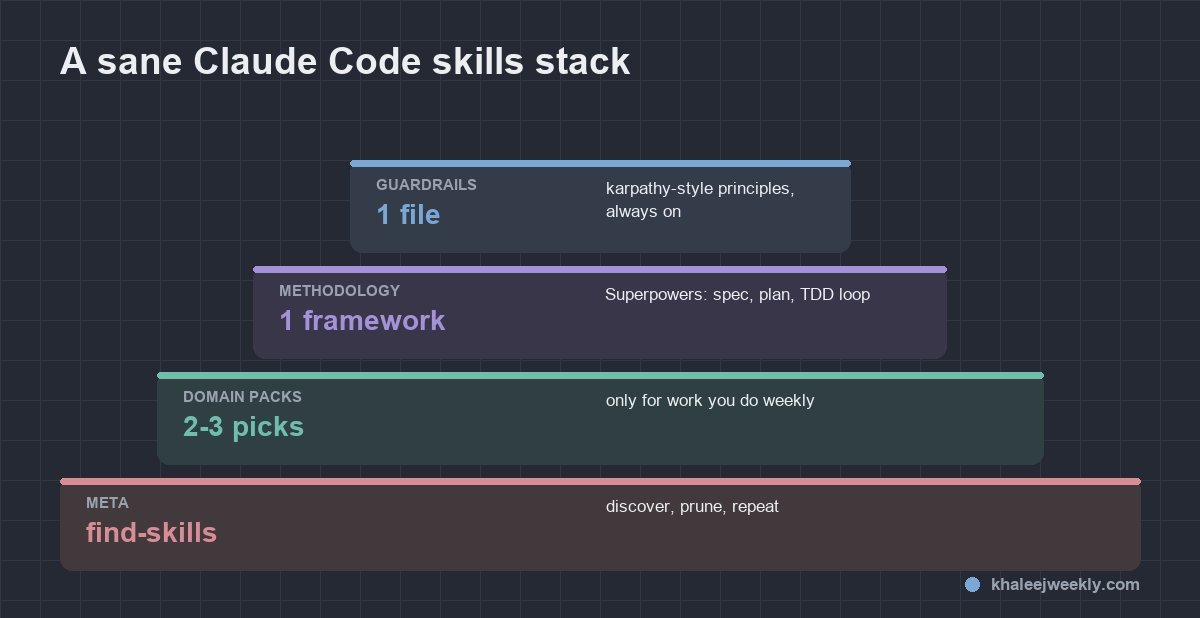
Star counts move daily; this week’s leaderboard is next week’s archive. What holds steadier is the shape of a good setup. It looks less like a list and more like a pyramid.
Superpowers, the one that behaves like a methodology
Superpowers is less a skill than a development process wearing the skill format. Fire up a request and it refuses to jump into code; it teases out a spec, shows it to you in digestible chunks, drafts an implementation plan aimed at “an enthusiastic junior engineer with poor taste,” then runs a subagent-driven loop with red-green TDD until the plan is done. Installation is one command from the official plugin marketplace, and the repo ships install paths for Codex, Cursor, Gemini CLI, OpenCode, and ten other harnesses.
It earns its 30-second pitch, and it also earns a longer look than a table row: our Superpowers review digs into what the methodology feels like on a real project and who should skip it.
The guardrail files, small and disproportionately useful
The Karpathy-derived file addresses failure modes anyone who codes with agents will recognize: wrong assumptions ridden without checking, thousand-line constructions where a hundred would do, comments deleted as collateral damage. Its four principles (think before coding, simplicity first, surgical changes, goal-driven execution) read like a senior engineer’s performance review of every LLM ever, which is roughly what the source material was.
These files cost one system-prompt line and change behavior on every task, the best token-to-value ratio in the whole ecosystem. Anyone unsure where to start should start there, with exactly one.
What the listicles don’t tell you
The best skills in circulation are not in any repo; power users build their own, and the ceiling sits far above the trending page:
“My most valuable skill is a meta-skill that observes my work sessions and logs skill improvement opportunities for all my skills (including itself) and then applies them in scheduled autonomous skill improvement sessions. It also recommends new skills to be created when there is no existing skill for a detected pattern. It has logged and applied more than 600 improvements across \~40 skills since I started using it.”
– r/ClaudeAI, April 2026 (246 upvotes)
Companies quietly publish theirs too; one commenter pointed to Bitwarden’s public skills repo and its retrospective skill as a daily driver. The pattern behind both examples is the same: the skills that stick are the ones grown out of your own recurring work, then pruned hard. A skill you have not triggered in two weeks is a token tax, not an asset.
Vet before installing, too, because a skill is instructions your agent will obey plus scripts it may run. The red flags are consistent: a bloated SKILL.md that loads thousands of tokens on barely related tasks, vague trigger descriptions like “use for productivity” that fire everywhere, and bundled scripts making network calls nobody audited. Reading one markdown file before installing takes a minute and is the entire security model.
FAQ
How do I install a Claude Code skill?
Framework-style skills install from the official plugin marketplace with one command, such as /plugin install superpowers@claude-plugins-official; standalone skill folders can be added with npx skills add <owner>/<repo> or dropped into your project’s skills directory. Restart the agent in that folder and the skill lists itself. Skills you want everywhere, like a guardrail file, are worth installing globally instead of per project.
Are Claude Code skills free?
The skills themselves are almost all free and open source, typically MIT or Apache licensed. Your cost is indirect: each installed skill adds a line to the system prompt on every turn, so a bloated collection quietly inflates token usage on whatever plan you pay for.
What is the difference between skills, plugins, and MCP servers?
Skills are instruction files that change how the agent works; plugins are the packaging and marketplace layer that installs them; MCP servers are live programs that give the agent new abilities to call, like querying a database. A skill teaches, an MCP server does.
Start with one guardrail file and live with it for a week before adding anything else. The gold rush will still be there, the trending page will have reshuffled twice, and you will know by then whether your bottleneck was the agent’s discipline or your own.

