


Superpowers is worth installing if your Claude Code sessions build real features on real codebases, and worth skipping if most of your requests are twenty-minute fixes. It is a full development methodology in skill form: spec first, plan second, then a subagent-driven TDD loop that can run for hours without drifting.
The hype is real and so is the backlash, and both camps are describing the same tool accurately. Which camp you land in depends less on the plugin than on what you ask your agent to do all day.
What Superpowers actually does
Install obra/superpowers and the change shows up on your next request: the agent declines to start coding. It interviews you until a spec exists, presents that spec in chunks short enough to actually read, then drafts an implementation plan written, in the project’s own words, for “an enthusiastic junior engineer with poor taste, no judgement, no project context, and an aversion to testing.”
Say go and it launches subagent-driven development: worker agents take engineering tasks one by one, their output gets inspected and reviewed, and the loop continues down the plan. The methodology enforces red-green TDD, YAGNI, and DRY throughout. Runs of a couple of autonomous hours without deviating from the approved plan are normal, which is the whole pitch: the plan you signed off on is what gets built.
Getting it is one command from Anthropic’s official plugin marketplace (/plugin install superpowers@claude-plugins-official), and the MIT-licensed repo ships install paths for Codex, Cursor, Gemini CLI, OpenCode, Copilot CLI, and about ten other harnesses, so a team split across tools can share one methodology.
The split verdict, and why both sides are right
Ask long-time users and you hear devotion:
“20 years swe, build software for living and Claude code incorporated into 100% my projects and workflows.. Would not start a single session without it.”
– r/ClaudeAI, June 2026 (14 upvotes)
The same thread’s top comment tells the opposite story:
“It slowed me down a lot, consumed way more tokens, and hit the limit much earlier than regular plans. With Opus, I eventually gave up using it. But with Fable, even in just 24 hours, I didn’t need anything else. Plain English was enough to explain what I needed… Love you, Fable…”
– r/ClaudeAI, June 2026 (32 upvotes)
Read together, the two comments explain each other. Superpowers is scaffolding, and scaffolding pays off in proportion to how much the underlying model needs it. Weaker or older models drift, skip tests, and overbuild, so a methodology that forces specs and review loops rescues real hours. The newest frontier models internalized much of that discipline, which shrinks the payoff while the token overhead of spec interviews and subagent loops stays constant. Neither camp is wrong; they are running different models on different work.
Who it fits, who should pass
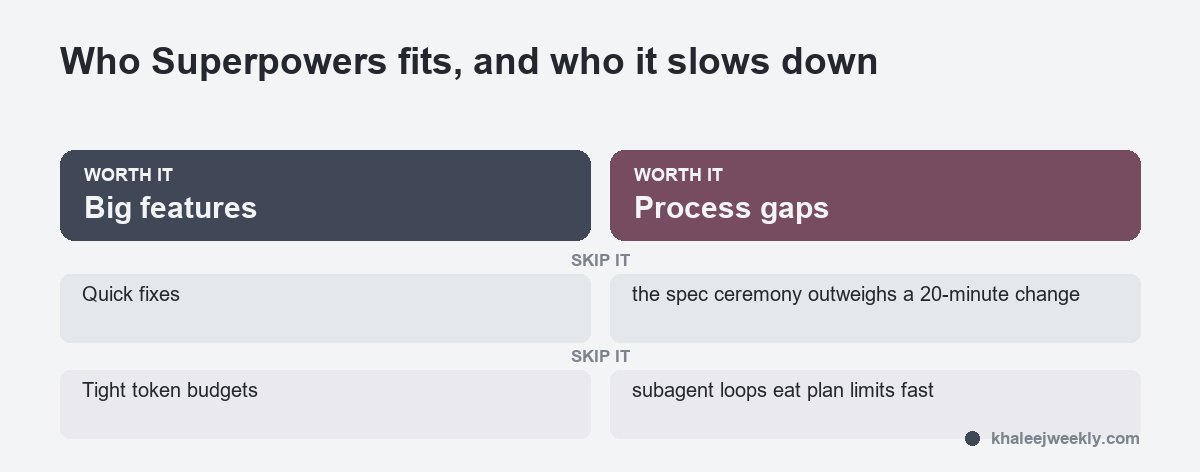
The overhead argument cuts hardest on small tasks. A rename, a bug fix, a config change: the spec ceremony costs more than the change itself, and seasoned users say exactly that when asked whether results vary by workflow, codebase size, and team shape. Power users who stay tend to build relay workflows around it, one popular pattern being brainstorm and plan at high reasoning effort, an outside model reviewing the plan, subagents executing, then a final cross-model review. That crowd treats Superpowers as the backbone of a pipeline, not a magic switch.
It also has a sibling rivalry worth knowing about: Everything Claude Code (ECC), another trending harness-optimization kit, gets compared against it in the same forums. The short version of that debate is that ECC tunes the agent’s environment while Superpowers imposes a process; they answer different questions and some setups run both.
FAQ
What do Superpowers skills do in Claude Code?
They intercept the normal jump-straight-to-code behavior and route every substantial request through a spec conversation, a reviewable implementation plan, and a test-driven subagent execution loop. The skills trigger automatically once installed, so there is no per-task ritual to remember.
Is the Superpowers plugin worth it?
For multi-hour feature work on codebases you care about, yes; the plan-first loop pays for its token overhead in avoided rework. For quick fixes, prototypes, or accounts that already bump into usage limits, the overhead is the product, and skipping it is reasonable.
How do I get Superpowers in Claude Code?
Run /plugin install superpowers@claude-plugins-official from Anthropic’s official marketplace, or add the author’s own marketplace with /plugin marketplace add obra/superpowers-marketplace first. Other harnesses, from Codex to Gemini CLI, have one-line installs listed in the repo.
If the roundup framing helps, Superpowers sits at the methodology tier of a sane setup, one layer above the guardrail files covered in our Claude Code skills field guide. Try it on one real feature, watch whether the spec interview saves you from your own vagueness or just delays it, and let that one run make the call.

