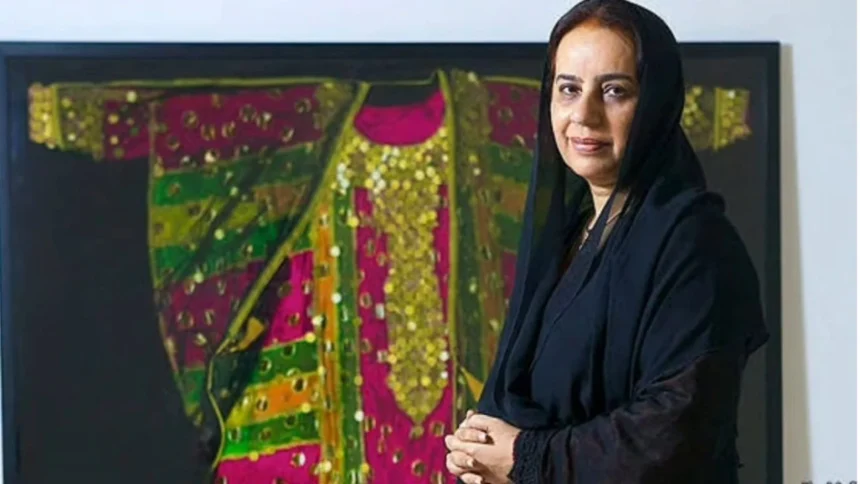

Ousha bint Khalifa Al Suwaidi (1920–2018) was an Emirati Nabati poet known across the Arab world by the honorary title Fatat Al Arab (“Girl of the Arabs”). Born in Al Ain and later based in Dubai, she is widely regarded as one of the finest Arabic Nabati poets of the 20th century. In 2022, Google honored her legacy with a Doodle recognizing her contribution to Arabic oral poetry.
Many of her poems have been turned into songs by well-known Gulf singers and are still recited and studied today. This guide covers her full biography, the story behind her title, the themes and style of her poetry, her awards, and where to read her work now.
Who Was Ousha Al Suwaidi?
Ousha bint Khalifa Al Suwaidi (Arabic: عوشة بنت خليفة السويدي), also known as Ousha Al Sha’er (“Ousha the Poet”) and Fatat Al Arab, was an Emirati Nabati poet born on 1 January 1920 in Al Ain, then part of the Trucial States, and she died on 27 July 2018 in Dubai at the age of 98.
She belonged to the Al Suwaidi family, whose full paternal line traces to Khalifa bin Ahmad bin Khalifa bin Khamis bin Ya’arouf Al Suwaidi. Her brother, Ahmed bin Khalifa Al Suwaidi, later served in a diplomatic capacity connected to the UAE presidency. She spent parts of her life moving between Al Ain, Qatar, and eventually settled in Dubai in her later years.
| Fact | Detail |
|---|---|
| Full name | Ousha bint Khalifa Al Suwaidi |
| Also known as | Fatat Al Arab (“Girl of the Arabs”), Ousha Al Sha’er (“Ousha the Poet”) |
| Earlier honorific | Fatat Al Khaleej (“Girl of the Gulf”) — used before 1989 |
| Born | 1 January 1920, Al Ain, Trucial States |
| Died | 27 July 2018, Dubai, UAE (age 98) |
| Poetic tradition | Nabati (colloquial Arabic oral poetry of the Arabian Peninsula) |
| First recognized | Age 15, for public poetry recitals |
| First published collection | 1990, compiled by poet Hamad Bin Khalifa Bou Shehab |
| Key honors | Abu Dhabi Award, Sharjah Festival of Classic Poetry recognition, Abu Dhabi Festival Award (ADMAF, 2019), Google Doodle (2022) |
Why Is Ousha Al Suwaidi Called “Fatat Al Arab”?
She was originally known as Fatat Al Khaleej (“Girl of the Gulf”) before 1989. That year, Sheikh Mohammed bin Rashid Al Maktoum — then Crown Prince of Dubai — dedicated a poem to her in his first published collection and gave her the new title Fatat Al Arab (“Girl of the Arabs”), elevating her recognition from a regional to a pan-Arab figure. The renaming was itself a form of public literary endorsement from the ruling family, and it is the name by which she is now most widely known across the Arabian Peninsula.
Early Life: How a Bedouin Girl Became a Poet Without Formal Schooling
Ousha was born into a family that hosted poets and valued literature at a time when formal education, especially for girls, was rare in the region. According to the Fiker Institute’s biographical essay, she taught herself to write by tracing letters with charcoal, since structured schooling was not available to her as a child in 1920s Al Ain.
Her father, Khalifa bin Ahmad Al Suwaidi, encouraged rather than discouraged her poetic ambitions — a notable exception in a literary scene almost entirely dominated by men at the time. She was immersed early in the Bedouin oral tradition, where poetry functioned as history, entertainment, and social commentary all at once, recited at gatherings known as diwan.
By age 15, her recitations had already earned recognition from established poetry circles — a genuinely rare achievement for a young woman in a male-dominated field during that era.
What Is Nabati Poetry, and Why Does It Matter Here?
Nabati poetry is oral, colloquial Arabic verse composed in the spoken dialects of the Arabian Peninsula rather than in classical (fusha) literary Arabic. Because it uses everyday language, it has historically been more accessible to ordinary people than classical Arabic poetry, and it has long served as an oral record of Bedouin history, values, and identity.
Ousha worked within this tradition but drew on classical influences too. Her style was shaped by canonical Arabic poets — Al-Mutanabbi, Abu Tammam, and Al-Ma’arri — alongside local Nabati figures such as Al Majidi bin Thahir and Rashid Al Khalawi. That dual grounding, folk form carrying classical technique, is part of why literary historians treat her as a bridge figure between old Bedouin oral culture and the more codified modern Emirati poetry scene that emerged after her.
Themes, Style, and a Real Example From Her Work
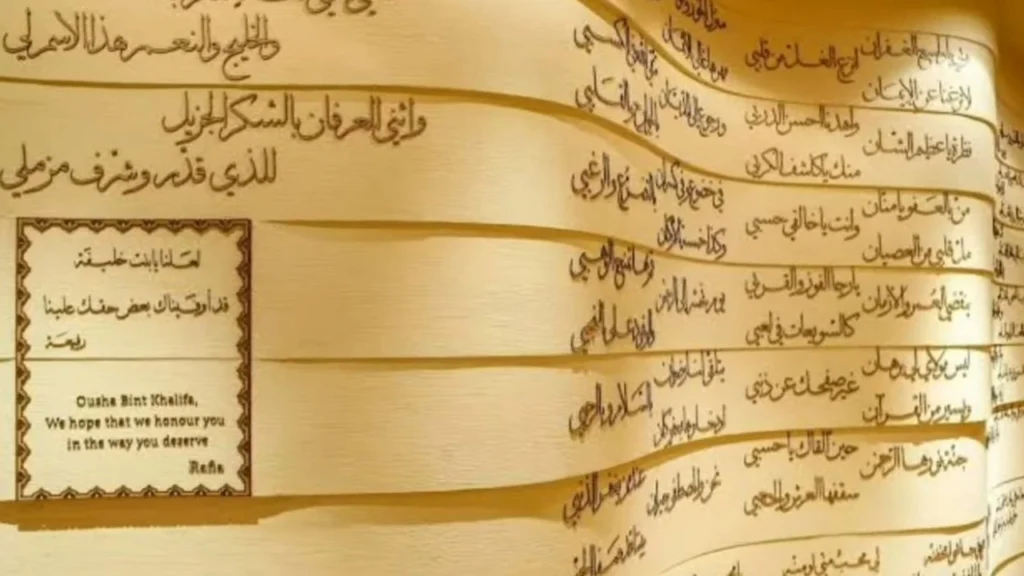
Her poetry consistently returns to a small set of themes: patriotism, praise (of leaders and of the land), nostalgia for a disappearing Bedouin way of life, wisdom, and love. The physical world of the pre-oil Gulf — desert sand, falcons, palm groves, and the sea — recurs constantly as imagery, because it was the world she was born into.
The Fiker Institute’s essay on her work highlights a verse built around pearl diving — the region’s dominant industry when she was born. The verse observes that not every diver surfaces with pearls in hand; some return empty-handed. Used as metaphor, this becomes a meditation on fate, effort, and the gap between hard work and reward — a theme any pearling-era Gulf audience would have recognized immediately, and one that still resonates as a proverb-like observation about perseverance today.
Timeline: Milestones, Awards, and Recognition
| Year | Milestone |
|---|---|
| 1920 | Born in Al Ain, Trucial States |
| c. 1935 | Recognized at age 15 for poetry recitals |
| 1989 | Given the title “Fatat Al Arab” by Sheikh Mohammed bin Rashid Al Maktoum, replacing “Fatat Al Khaleej” |
| 1990 | First poetry collection published, compiled by Hamad Bin Khalifa Bou Shehab |
| 2000 | Second edition of her collection published |
| 2009 | Received an Abu Dhabi Award for her services to culture |
| 2010 | Honored at the 11th Sharjah Festival of Classic Poetry |
| 2011 | Official biography published by Dr. Rafia Ghubash; annual award for female Emirati poets established in her name; a section dedicated to her at Dubai’s Women’s Museum |
| 2018 | Died in Dubai, aged 98 |
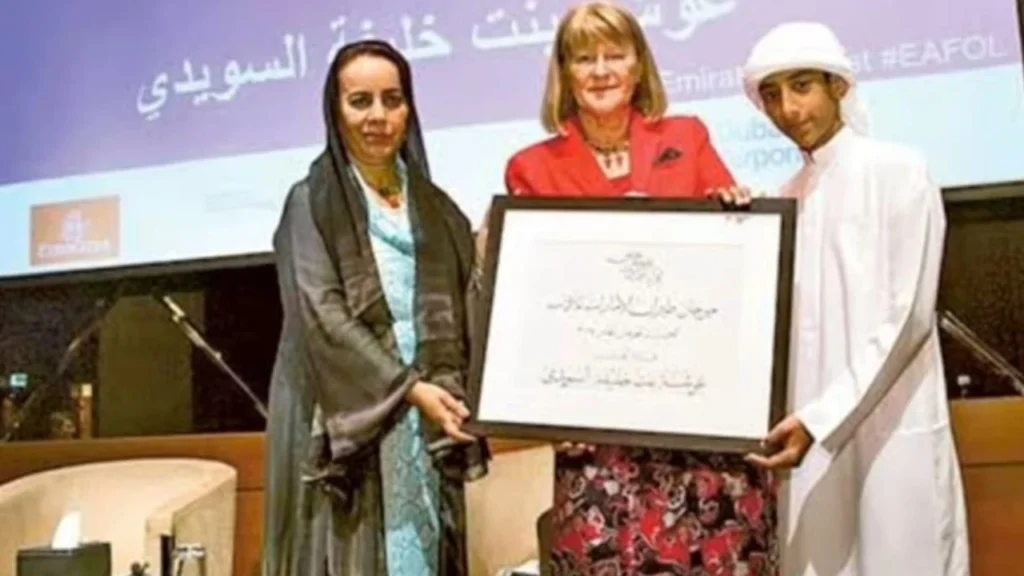
| 2019 | Posthumously awarded the Abu Dhabi Festival Award by the Abu Dhabi Music & Arts Foundation (ADMAF) |
| 2022 | Honored with a Google Doodle on 28 November, illustrated by Abu Dhabi-based artist Reem Al Mazrouei |
Note: some secondary sources sequence the 2009/2010 awards slightly differently; the dates above follow Wikipedia’s sourced timeline and the Abu Dhabi Awards’ own recipient records.
The 2022 Google Doodle: Why Google Honored Her
On 28 November 2022, Google published a doodle celebrating Ousha Al Suwaidi as one of the greatest Nabati poets of the 20th century. The illustration was created by Abu Dhabi-based artist Reem Al Mazrouei, who reportedly went through roughly 15 days and ten versions to arrive at the final image, according to reporting in Khaleej Times. The doodle introduced her to a global audience well beyond the Gulf region and is the single biggest driver of search interest in her name today.
Legacy: What She Changed for Emirati and Gulf Literature
Ousha Al Suwaidi is credited with two lasting effects on the region’s literary culture. First, she helped preserve Nabati poetry as a living oral tradition during a period of rapid modernization in the UAE, when much of that heritage risked being lost as the country urbanized quickly after independence. Second, she became a visible, publicly celebrated example of a woman succeeding in a field that had almost entirely excluded women, opening space for the generation of female Emirati poets who followed her.
The Ousha Bint Khalifa Al Suwaidi (Fatat Al Arab) Foundation, established by the family, continues this legacy today, maintaining her archive and supporting literary initiatives in her name.
Where You Can Read Her Poetry Today
- The Ousha Foundation’s official site (ousha.ae) — biography and archive maintained by her family
- Her published poetry collections — first released in 1990, second edition in 2000, compiled with Hamad Bin Khalifa Bou Shehab
- Her official biography — written by Dr. Rafia Ghubash, President of the Arabian Gulf University in Bahrain
- The Women’s Museum, Dubai — a dedicated section on her life and work
- Recorded song adaptations — several of her poems were set to music by well-known Emirati and Arab singers, which remains the way many people first encounter her verse
Frequently Asked Questions
Who was Ousha Al Suwaidi?
She was an Emirati Nabati poet, born in 1920 in Al Ain and known across the Arab world as “Fatat Al Arab.” She is considered one of the finest Arabic Nabati poets of the 20th century and died in Dubai in 2018.
Why is she called Fatat Al Arab?
Sheikh Mohammed bin Rashid Al Maktoum gave her this title in 1989, replacing her earlier nickname “Fatat Al Khaleej” (Girl of the Gulf), after dedicating a poem to her in his own published collection.
When did Ousha Al Suwaidi die?
She died on 27 July 2018 in Dubai, at the age of 98.
What is Nabati poetry?
Nabati poetry is oral verse composed in the everyday spoken dialects of the Arabian Peninsula, rather than classical literary Arabic, historically used to record Bedouin history, values, and social life.
Why did Google create a doodle for her?
Google honored her on 28 November 2022 as one of the greatest Nabati poets of the 20th century, with the illustration created by Abu Dhabi-based artist Reem Al Mazrouei.
Did Ousha Al Suwaidi have formal education?
No — she grew up at a time when formal schooling was rare, especially for girls, in Al Ain. She is said to have taught herself to write using charcoal to trace letters.